Sunday, September 2, 2012

Review: The Music of the Primes by Marcus du Sautoy


The Music of the Primes: Searching to Solve the Greatest Mystery in MathematicsThe Music of the Primes: Searching to Solve the Greatest Mystery in Mathematics by Marcus du Sautoy
My rating: 4 of 5 stars

It is with books like these that I wonder why I never chose to study mathematics further. I would like to believe it was due to the abysmal, 'learn-by-rote and don't explore' method that I was forced to follow in the rat-race to pick a career. It is extremely unfortunate that I ended up quitting the subject with quite some vitriol, but it is even more unfortunate that I have begun to discover, a little too late, the very subject's beauty. Well, better late than never, right?
But hey, if I really hated mathematics, I should have never looked again at a book that extolled it. Maybe I wanted to redeem myself? Nah! Some part of me probably wanted to give it another chance despite the fact that it always tried to bring me down (all those damn exams!).
Anyway, it was with some haughtiness that I gave into this book. "Stupid mathematicians-I thought-trying to build something really difficult out of something as simple as 1,2,3...stupid theorems, stupid proofs that ended with 'hence proved'"-the rants in my head wouldn't end. I never saw the beauty of primes, never thought them special, actually I never really thought of them after high school. It didn't help that the book is written by a professor of mathematics who gushes over the subject somewhat unabashedly and with seemingly low regard for other disciplines. Sample this- "Those names [certain mathematicians] will live long after we have forgotten the likes of Aeschylus, Goethe and Shakespeare". This is just an absurd argument to me and something I completely disagree with. Really intelligent, well-read people will remember both mathematicians and bards alike, not to mention other significant scientists and artists. A really small point, but it began to put me off the writing, until I began to really get into why the Riemann Hypothesis is such a big deal and the interesting history of mathematics (I think the history more than the math part of it was interesting to me until a certain point and then maths soon began to catch up).
It was interesting to get into the minds of these brilliant mathematicians and read about how math played a role in their lives. It was nostalgic reading about the zillions of theorems that I had touched upon in another life and I felt incredibly patriotic reading about the contributions of Indian mathematicians and-believe it or not-a certain quote by an eminent British mathematician that the Indian education system played a huge role in honing his skills! (Wow, was it just me then?)
But most of all, it was fascinating to read about how little is known of the primal beat and how knowledge of at least a few of the prime numbers' secrets, starting with the Riemann Hypothesis may be linked to quantum theory and eventually a better understanding of the universe. I enjoyed the rare glimpses of humor in the author's writing [for e.g. while referring to the strange case of the autistic twins in Oliver Sacks book The Man Who Mistook His Wife for a Hat & Other Clinical Tales -"Before anyone could find out how they were doing it, the twins were separated at the age of thirty-seven by their doctors, who believed that their private numerological language had been hindering their development. Had they listened to the arcane conversations that can be heard in the common rooms of university maths departments, these doctors would probably have recommended closing them down too"]. However, the constant reminders of monetary benefits to solving problems of such significance were a bit of a turn off. Isn't eternal fame enough?
I feel like this book deserved the 4 stars I gave it, because despite some disagreement with his tone, I overall agreed with Prof. du Sautoy in that I was completely wrong in dismissing mathematics as a boring subject with no value in real life except for simple arithmetic calculations.

View all my reviews

Thursday, August 23, 2012

Saturday, August 4, 2012

Review: Titus Groan by Mervyn Peake


Titus Groan (Gormenghast Trilogy, #1)Titus Groan by Mervyn Peake
My rating: 4 of 5 stars

In the words of Mrs. Slagg, "Oh my poor heart!" This book is definitely not an easy read! Part humorous, dull, convoluted and yet enticing, lets just say I am glad this book wasn't spoiled for me as a high school read, like say *cough* 'Great Expectations'.
The detail that an artist puts into paintings is what you get when that artist decides to write a book. I read another book by a contemporary artist, the highly publicized ' The Night Circus' and while in that case the story was dull, the writing pretentious, in 'Titus Groan' you get such intimate details of each and every scene, that you might be fooled into thinking the story is dull. I can assure you it is not! While not exactly your fast paced thriller of a fantasy, ' Titus Groan' (which dwells on expanding on every caricature of a character) is a wonderful stage setting to the protagonist whose name is the title of this novel. However, that means, you do not get to see him as much as the surroundings in which he is destined to thrive. I say thrive, because Gormenghast Castle at its best is a mad-house. A place full of strange characters. How did Peake even come up with them?
Each character is so well etched, that the next time I find someone named Cora, or Clarice, I am going to assume they are as batty as the twins in the book. The vocabulary is amazing and the names of the characters roll of your tongue. Soon, you'll love the many eccentricities, be it the stolidity of Mr Flay, the moroseness of the bibliophilic Lord Sepulchrave (I loved that name!), the frostiness of his wife, Gertrude, the batty helplessness of the twins Cora and Clarice, the dreaminess of Lady Fuchsia, the reverent love of the old Nannie Slagg, the jolly, nerdy Dr Prunesquallor (again, love it!), his intolerable sister, Irma with a tendency to repeat her words forcefully when making a point, the homicidal Abiatha Swelter and the cold, calculative, ambitious Steerpike. Against all of these, the castle of Gormenghast forms its own character, the expansive, crumbling walls holding fort for these many weirdos without falling apart altogether. The second book is called Gormenghast and I wondered many a times if these two books should have had their titles swapped.
The book was exhausting, and at many points I felt tired and did not want to read another word. But then some of the wonderful, comic lines would pop up in my mind and I wanted to see if there were more. Hell, the book was about to end and Titus was not even a boy! I wanted to know what was up with that. And then right towards the end there was a morbid twist, that despite the sluggish pace of the narrative kept me hooked.

Anyways, I'd not recommend this book to readers who prefer somewhat of a pace in their book. I fear they might end up ruining the rating of this weird yet likable ( for people like me) book.

View all my reviews

Monday, July 23, 2012

Review: The Charwoman's Shadow by Lord Dunsany


The Charwoman's Shadow (Del Rey Impact)The Charwoman's Shadow by Lord Dunsany
My rating: 4 of 5 stars

I am willing to give Lord Dunsany the benefit of four stars, despite the rude connotation that Lord Vishnu is someone a follower of Dark Arts would pray to. Dunsany was a learned man and another book by him makes light of religion as such, so I was somewhat taken aback at this bigotry. Anyway, like I said, I'll not let that stand in my review of a book that I really enjoyed.
The story follows the travails of a young man, Ramon Alonzo who has to learn the art of making gold from a sorcerer so he can accumulate enough dowry for his only sister, Mirandola. The poor man soon finds out the terrible price of learning anything from this evil man, but must keep going because of his love for his sister and out of chivalry towards an old charwoman who is desperate for her shadow that was taken by the sorcerer.
Lord Dunsany writes about a simpler time, when the marriage of a daughter, with a big fat dowry for her future husband was top-most priority, a scenario, that sadly still unfolds in many a place. However, Lord Dunsany gives Mirandola a strong character and lets her take her destiny in her own hands, something perhaps not very common in those times. As usual, the story is made entertaining by the many intelligent quotes and the importance of losing something one takes for granted (like one's shadow) is exemplified by the terrified and hostile attitude of society towards an anomaly like that. The overall tone of the book remains hopeful and at times even funny, especially with Dunsany's trademark humor which in this book concerns the psychology of a dog!
I still am not sure why the knowledge of boar hunting (taught by Alonzo's ancestor to the sorcerer) was such a big deal that the sorcerer felt so obliged to teach Ramon Alonzo something in return. I guess hunting is an integral part of Dunsany's works no matter what they are about, so I won't dwell on it longer, but Dunsany's style is surely growing on me.


View all my reviews

Wednesday, July 11, 2012

Review: The Gods of Pegana by Lord Dunsany


The Gods of PeganaThe Gods of Pegana by Lord Dunsany
My rating: 3 of 5 stars


Clearly, this was sort of an inspiration for 'The Silmarillion'. Do not look for a story because there is none ( except if the slumber and awakening of Mana-Yood-Sushai is considered one). Instead look at the brilliant word-play, the ease with which worldly concepts are described and the scope of the world created and it will amaze you. The Gods of Pegana have a voice, unlike the gods in 'The Silmarillion' and they can be unforgiving, unwavering and at times cruel.
They are the heroes of the book, not the innumerable earthlings they create, for not much is spoken about them. I really enjoyed this book and luckily my fondness for Dunsany's language has only increased. Onto his other works now! ( In case you are wondering,'The Worm Ouroboros' is not gripping enough for me yet)


View all my reviews

Monday, July 2, 2012

Review: The King of Elfland's Daughter by Lord Dunsany


The King of Elfland's DaughterThe King of Elfland's Daughter by Lord Dunsany
My rating: 4 of 5 stars


This is my first introduction to a work of fantasy beyond Tolkien's or Rowling's and I am glad to report that I absolutely loved it!


First published in 1924, the book is written in remarkably beautiful prose, something sadly lacking in the current crop of fantasy fiction with unabashed and unnecessary violence and vulgarity. Lord Dunsany's writing is just a little short of poetry and I frequently came across passages that were so beautifully described that it was as if a motion picture were playing in my brain.

Interspersed through the sad love story of Alveric and Lirazel, is the tale of an ambitious parliament of the Vale of Erl who fear their village might be lost in the annals of history. And so their solution is to ask the King to bring magic to their town. To fulfill this quest, the King's son, Alveric, must win in marriage, the daughter of the King of Elfland. This is duly done but the story has only begun. What follows is the unfortunate interference of the Freer and his religious biases which crack the relationship between Alveric and the free-spirited Lirazel. As she returns to her father's home, Alveric realizes his folly and seeks her in a long-drawn and seemingly vain quest.

My personal favorite chapters were, the one in which a unicorn hunt is led by Lirazel's son, Orion and another in which Lirazel finally realizes she wants to be with Alveric and her son despite all. The descriptions of the King of Elfland, the witch Ziroonderel, the Freer , the men of the parliament,the trolls and the will-o-the-wisps move with such rapidity from serious (in the case of the former three) to whimsical (for the latter) that it is surprising that they fit so well within the same story. I was completely caught off-guard by the characters of the trolls. A far cry from the meandering, sluggish and cruel trolls from other works of fantasy, the trolls described in this book are fun and smart. Alveric, on the other hand, not so much. Once wedded to Lirazel, he is frequently unimpressed with her, forces his religion upon her and fails to understand her vanity that stems from her immortality.

The book also mentions religion, but it does not seem to condone it, and there are several references to how religion has mostly served to severe bonds of love, despite claiming to persevere towards building them. Cases in point: ["And Alveric did not know that the time must come when some simple trivial thing would divide them utterly"; "And the Elfland poured over Erl. Only the holy place of the Freer and the garden that was about it remained still of our Earth, a little island all surrounded by wonder, like a mountain peak all rocky, alone in air when a mist wells up in the gloaming from highland valleys and leaves only one pinnacle darkly to gaze at the stars"]
However, Lord Dunsany does not preach. He simply reminds us as to how careless wishes can eventually come true as something completely undesired, and how age often makes one discard the childhood curiosity and enthusiasm for a lot of things, especially magic, if not with some contempt, then definitely a new-born fear.

The 'magic' mentioned in the book is that which might enchant children and that which adults have nearly lost a sense of. However, this is by no means a children's book, despite the playfulness similar to "The Hobbit". Every chapter, however mundane (For e.g. Lurulu Watches the Restlessness of the Earth) is imbued with deep allegories of time, space and religion.

Lord Dunsany's frequent repetitions of "that which may be told of only in song" was somewhat less of an irritation to me than Martin's frequent "Winter is coming" chants, only because I noticed that the former phrase weaved into the metre of the sentences in which it was used, while the latter....oh well!

I think I am going to try another of his books, but for now, I am drawn towards a mammoth of a book called The Worm Ouroboros by E.R Eddison, which according to my Nook seems to have 2303 pages!

View all my reviews

Wednesday, June 27, 2012

A Waiting Game


As days pass, I can think of more and more reasons why I am leaning closer to e-books.
Just yesterday, I came across this article
http://designtaxi.com/news/352828/Perfume-That-Lets-You-Smell-Like-Books/
Now we, book lovers, can't play our "Oh I like to smell my books" card, can we?
Another, bigger reason, is the seemingly endless wait for a book to arrive. Yes, yes, I know I can always buy books directly from the store, but recently I was longing to read a book that has been out of print for a long time and only a few copies of which exist. Obviously this book does not yet exist in an e-book version, otherwise a click would have saved me a lot of heartache.
I also do not like buying used books online. Buying them in person is preferable. So the only place I ended up finding a 'new' copy was at Amazon. I gave in and also signed up for  "Amazon Prime" to have it shipped to me as soon as possible.
What did I get?
'Free' shipping by a company named Lasership (!?), a sense of euphoria, after my two day shipping turned into a one day shipping (which at one point I thought was completely misleading) and then there I was at the end of the workday still waiting for my book. And it was almost time to go home......
So, you can only imagine the speed with which I leapt out of my chair when the email pop-up from the front-desk notified me that my package had arrived. I did not even bother to read it's contents, the title was enough!
 And so presenting my latest read..


Now I only hope it is as good as the reviews make it out to be!

Sunday, June 17, 2012

Review: What a Plant Knows by Daniel Chamovitz


What a Plant Knows: A Field Guide to the SensesWhat a Plant Knows: A Field Guide to the Senses by Daniel Chamovitz
My rating: 3 of 5 stars

I cannot say I simply loved this book. It reminded me too much of a botany textbook, despite the author's best attempts to make it interesting. I understand that the author could not put a lot of the theory in layman's terms, but if even someone like me who is moderately familiar with botany found it dull in parts, then it definitely is not a book for someone with no previous background in botany. That said, it was very informative, extremely well written and I hope most of the information will be stored in my long-term memory, like that in a flax seedling(!).
It is a relatively short e-book at 129 pages, only 94 of which contain the actual material, the rest being acknowledgements and notes. The book is divided into six parts, based on the 4 main senses (vision, olfaction, auditory, somatosensory), sense of location and memory, that plants may or may not share with humans and animals. Each chapter begins with an interesting fact about the similarities in one of the above mentioned senses between plants and humans. The most famous example quoted several times in the book is obviously the enigmatic Venus Fly-trap that intrigues children and adults alike and every botanist's favorite, Arabidopsis. The chapter on how several people carried out experiments to prove that plants preferred a certain genre of music was informative and hilarious at the same time. It reminded me of a page in a childhood encyclopedia, called "The Big Book of Amazing Facts" with the title "Why do some people sing to their plants?" It depicted a large woman in an 'opera singer' sort of stance singing to her plant. I do not remember the conclusion in that chapter, but I think it was something to the effect that it was because people thought you could induce plants to grow faster if you spoke to them or even better, sang to them. Considering that my encyclopedia is from the eighties, it is not a surprise that research has since debunked that myth.
But apart from the fact that plants lack the auditory sense(spoiler alert!), the knowledge that plants possess rudimentary forms of the remaining senses was slightly unnerving to me. I mean, I always knew plants were living beings (duh!), but understanding the extent of their 'life' makes me, a life-long vegetarian, ponder my non-existent options for non-violent means of obtaining food. Maybe one day humans will learn how to make their own food with just air, water and sunshine!
As for the rating for this book, I gave it 3 stars because I only just 'liked it'(as opposed to 'really liked' or found it simply 'amazing'), but in terms of information, this book would be well worth five.
All I know is that I'll never look at Felicis, my bamboo plant that sits on my office desk, the same way again!

View all my reviews

Saturday, June 16, 2012

Review: The Palace of Illusions by Chitra Banerjee Divakaruni


The Palace of Illusions: A NovelThe Palace of Illusions: A Novel by Chitra Banerjee Divakaruni
My rating: 4 of 5 stars

I found this book in one of the last Borders bookstores and it was on sale for only five dollars!I bought this book and 'The Grand Design' together last January, but I haven't read the latter yet.
One of my biggest fascination with the story of Mahabharata is because of a lesser known twist to the tale and so I was absolutely thrilled that 'The Palace of Illusions' promised to talk about it.
'The Palace of Illusions' refers to the ephemeral palatial home of the Pandavas from whose balcony, Draupadi mocks the 'villain' Duryodhana and sets into motion the cascade of events culminating in the great War at Kurukshetra.
Draupadi, the enigmatic heroine in Mahabharata and her brother Drupad, were children born out of a sacrificial offering performed by King Drupad. He burned with anger at being humiliated by Guru Drona, who was the official teacher of the princes of Hastinapura and prayed for a son who'd avenge him. In addition to the son he desired, the gods bestow upon him a beautiful daughter as well.
Draupadi, in a previous birth, greedily prays to Lord Shiva for a husband who would be just, skilled, strong, handsome and gentle(who can blame her for wanting everything?). But God, being who He is, pulls a fast one on her. In her next birth (as Draupadi), she ends up being married to five brothers, each of who embodies one of the traits mentioned above.
The original Mahabharata, narrated by Sage Vyasa, only glosses over the travails of the hapless princess who must share her conjugal life with five husbands. In Banerjee's book, Draupadi gets a voice of her own.
And with her voice, spill her secrets.
Banerjee takes a few liberties with the story. With Draupadi at the forefront, her husbands, the Pandavas are reduced to the background as mere props, except at the end, where she allows Bhima a somewhat three dimensional character. Banerjee's description of her as a child-woman needing her 'Dhai Ma' at the beginning of the story was a little confusing to me. Technically she should have appeared as a full-grown woman  in the sacrificial fire, considering her father had already been humiliated by the Pandavas before she was 'born'.
I absolutely loved the relationship portrayed between her and Karna (my most favorite character in the epic). Who can resist a tall, dark, brooding hero? But my subsequent read, 'Mrityunjaya, The Death Conqueror: The Story Of Karna', in which Karna is portrayed as ever faithful and ever loving to his wife Vrishali, left me very conflicted. There is an anecdote which tells the story of how Krishna reveals to Draupadi that she would have been better off if she had not rejected Karna at her Swayamvara, because he alone had all five qualities that she desired for in her husband. Considering the fact that it was he who initially prevented her from marrying Karna, this must have been a big *facepalm* moment for Draupadi. Of course, all of these stories are just wishful writing by the authors, but I sure love the theories!
Another change from the original is the fact that Banerjee writes about Draupadi witnessing the War like Sanjay(i.e. with the minds eye) but the War itself is relegated to just a few pages. There was so much potential here!
In all, the book is a lovely short read, but by no means a literary classic. I liked Banerjee's writing and wish she would have written a much more comprehensive book rather than just protraying one of the bravest (and notably arrogant) heroines in Hindu mythology as a mere whimsical woman.


View all my reviews

Friday, June 15, 2012

Review: Born to Run by Christopher McDougall


Born to Run: A Hidden Tribe, Superathletes, and the Greatest Race the World Has Never SeenBorn to Run: A Hidden Tribe, Superathletes, and the Greatest Race the World Has Never Seen by Christopher McDougall
My rating: 3 of 5 stars

I want to live..like animals, careless and free..
I want to live..I want to run through the jungle..
the wind in my hair and the sand at feet!
- Savage Garden


I recently started loving running and so when a friend rated this book on Goodreads, I was drawn immediately to its name. I am not a runner at all. A couple of years ago I couldn't run five minutes without a stitch in my side and my lungs ready to explode. Then thanks to a corporate 5K race in 2010, that I signed up for, I ran the entire distance in 43 minutes (and was the last one from my company to cross the finish line!). However, I was left with a sharp pain in my right knee which recurs frequently to this day (especially if I run after I have been lazy for a few days). As I kept slowly pushing myself, I was able to run a distance of 5Km in 21 odd minutes by last October! No pain, no stitch, just plenty of endorphins.
'Born to Run' by Christopher McDougall begins with him facing a very similar problem and his quest to find out why he was not suited to run despite being in good health. During this time, he learned about the Tarahumara tribe, Mexico's Copper Canyon dwellers, who are known to run for days with no adverse effects on their knees or feet. Although, how the author intended to solve his problem by learning more about the ways of this tribe is beyond me.
Instead, McDougall ended up compiling an enormous amount of information about superathletes (I honestly do not remember any of their names, except for one) who look like and live among us, but can run hundreds of miles at a stretch. I loved the story of Ann Trason, who started jogging 9 miles to and from work each way (18 miles a day, people!), between twenty-five to thirty miles on weekends to unwind, and eventually competing in and setting the women's record for the Leadville ultramarathon. Her time? 100 miles in a little more than 18 hours! Yay woman-power!
Apart from Ann, McDougall intersperses the story of several ultra-runners who run with as much ease as the Tarahumara tribe, against the backdrop of an ultra-marathon, the Leadville 100.He also describes how companies that make running shoes are actually fooling people with their claims of making shoes that 'cushion' your feet as you run. Human feet which evolved from the fins of some primordial aquatic being, says McDougall, are the only part of a human body which did not evolve as well as the human brain or fingers. So we are stuck with feet that cannot adapt well to the ground if cushioned in shoes (It would be akin to blinding someone and making them paint intricate art. And we all know it takes some very, very strong will-power and perseverance to achieve that, and that it is not something just about anyone is capable of.) The solution? Bare-feet running! However, I don't think the book convinced me to try it after all. No matter what the benefits are, I cannot subject my poor feet to the filth outside.
Some of the first few anecdotes were interesting to me, but I quickly started losing interest with the numerous names thrown into the book and to me most people started to seem the same. They were normal, until they started running marathons, and then ultra-marathons.
The book is definitely an extensive account of people who simply love running. So if you really enjoy the book, you've got to be (or might turn into) one of the people who run just for the sake of it-not for weight loss, not just for good heart health-but just to be in one of the most primal states of mind.


View all my reviews

Thursday, June 14, 2012

Review: Heidi by Johanna Spyri


HeidiHeidi by Johanna Spyri
My rating: 5 of 5 stars

I read 'Heidi' when I was in the 6th or 7th standard and fell in love with the beautiful descriptions of sunshine on mountain slopes, primroses and wildflowers, forget-me-not blue skies, fresh goat-milk, cheese, warm bread, cozy beds of hay and soft white rolls.
Heidi is a sweet little girl who is abandoned by her aunt at her grandfather's hut in the Alps, after her mother's death. Unfazed by her circumstances, Heidi revels in her new surroundings, thaws her surly grandfather and makes friends with a goat-keeper named Peter, his mother and grandmother.
Three years pass and everything is perfect in Heidi's life until her Aunt Dete arrives to take her to Frankfurt as a companion to a rich but invalid girl. Claustrophobic in her new life, Heidi longs for the freedom of her mountain life and her loving grandfather and endeavors to get back.
I recently realized that Johanna Spyri wrote this book in 1880 and I was extremely surprised at how old the book was. Even more so when I started re-reading it. Most of the translation was really bad, and some names did not seem familiar (e.g. A village woman's name as I remember was Barbel, but is Barbie in this new book. Clara is Klara and Aunt Dete is 'Detie'). Miss Rottenmeier (in this edition) was referred to as 'Fraulein' in my old copy which is how I came to learn that word as a kid. I also realized that Heidi was mostly preachy and too good to be true. It is interesting how I never understood these nuances earlier. Oh wait, I was a kid too!  To make things worse, I also read somewhere recently that Johanna Spyri could have ripped off this story from a relatively unknown author, Adam Von Kamp, who wrote a similar story some 50 years before Heidi was published. Sigh!
I am not sure I want to re-read my childhood books for nostalgia anymore. I'd rather leave my memories unsullied. However, despite all the tarnishing that I perceived as an adult, I consoled myself with the fact that 'Heidi' to me was mostly about the soft white rolls! But wait for it.....
The biggest dampener on my childhood imagination was brought about by my realization that 'soft white rolls' are actually
and not as I always imagined them in my naivety as...

Thanks Google, adulthood and reality!
View all my reviews

Tuesday, June 12, 2012

Review: Ex-Libris: Confessions of a Common Reader by Anne Fadiman


Ex Libris: Confessions of a Common ReaderEx Libris: Confessions of a Common Reader by Anne Fadiman
My rating: 5 of 5 stars

I had not heard of Anne Fadiman and did not even pick this book because it was written by her. It came as a recommendation after I had read some other book. But after reading her work, there is no denying that I'll continue to pick out her books because they have been written by her.
This book is a collection of 18 essays, in which she describes the love for books and literature that runs in her family and close friends. I wish I could discuss each and every one of them with someone who has read this book too, but alas! Maybe soon.
Beginning with her first essay in which she describes how she and her husband "married" their libraries, Anne Fadiman, goes on to describe the competitive literary games played by 'Team Fadiman' consisting of her parents, brother and herself and her penchant for proof-reading EVERYTHING! My most favorite part was when she described how her family believed in carnal love for books and not the usual reverential sort that most book-lovers believe in. That her father would tear off finished chapters of the book he was reading to 'lighten' his luggage on a trip, or that her husband would read books in a sauna, made me cringe with pain. I think her friends,the one who would not use a thick bookmark in case it left marks upon the pages, or the one who would follow around his mother-in-law until she replaced his book, are someone whom I'd be more comfortable lending my books to.
Her essay (My Ancestral Castles) where she touches upon the idea that children's taste for reading stemming from their parents reading habits, was also one that I enjoyed. My parents never hesitated to buy us encyclopedias, children's books and fairy tales. But if I and my sister had not seen my parents read (even if they were just reading the newspaper, a Marathi book or religious texts), we would probably not have had the same love or respect for reading.
Fadiman's command on the written word is unquestionable, but what is even more surprising, is that her essays keep you interested no matter what they are about. She can write about pens, or mail order catalogues and still be funny and enthralling. It is a high feat indeed if instead of finding her slightly narcissistic tone annoying, you find yourself relishing it.
I'll be definitely going back to her essays, because despite their quirks, I really liked the Fadiman family and I am sure I'll find these essays as interesting as the first time around. I also intend to find the meaning of all the words she mentions in her essay (The Joy of Sesquipedalians) and quiz some poor, unsuspecting soul one day! Maybe her love for proof-reading rubbed off on me, but page 78 and 88 of my e-book had some very noticeable typos (which I blame solely on the e-book publisher). I'll leave you to find them for yourself!

View all my reviews

Thursday, June 7, 2012

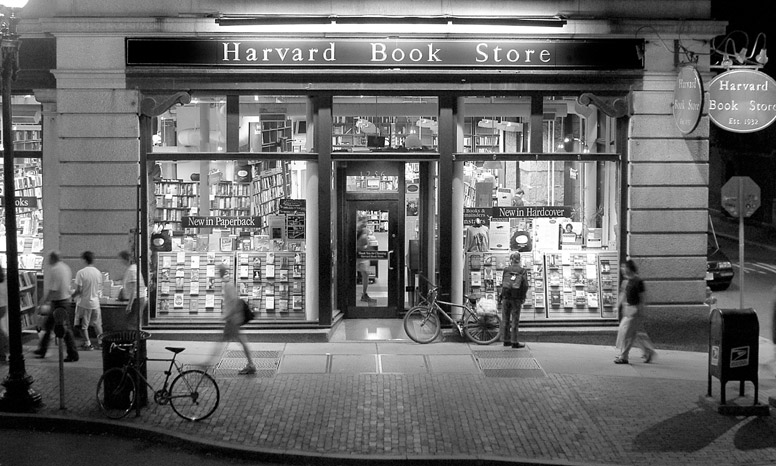
The Harvard Bookstore-so different, yet so familiar


I never knew how different bookstores could be! Instead of going to my usual Barnes and Noble store at the Prudential mall, I checked out a small store (although a giant in its own way) called the Harvard Book store and found it as different from Barnes and Noble as chalk from cheese (pardon the cliche!).
Titles I had never heard of, stared at me and books I love were available in every edition possible, something that is horribly amiss at Barnes and Noble with its more commercial culture (by which I mean every random 'best-seller' taking preference over really good books).
In the 'used' book section, I was taken back to my school days when nearly every Sunday morning I and my sister would ask our dad to take us to the curbside bookseller who sold cheap, used paperbacks. The more we bought, the faster they'd all be read. But the brat in me always wished for more.
I was distracted by a woman and her five or six year old, who seemed hesitant at being in the used books section. I heard the mother quietly explain to her daughter that it was a good practice to buy used books until you could afford the new, crisp ones and that way she could have as many as she wanted! I couldn't help feeling slightly ashamed at not being as understanding as the little girl, who promptly started picking out books. That was one of the reasons that made me put back  a beautiful, illustrated and annotated hardbound edition of 'The Hobbit' in its place and instead come away with two really inexpensive titles that cost me a total of 10$. It was not because I could not afford to, it was more to check myself from spending money just because I could afford to.
Anyhow, the following is the article that attracted me to the bookstore, (which I had not entered despite passing it by twice every day to and from work). Check out the article AND the bookstore!
Picture Courtesy: www.forbes.com/2005/12/14/cx_sb_1215featslide.html

http://www.forbes.com/sites/philjohnson/2012/05/10/the-man-who-took-on-amazon-and-saved-a-bookstore/

Review: The Yellow-Lighted Bookshop by Lewis Buzbee


The Yellow-Lighted BookshopThe Yellow-Lighted Bookshop by Lewis Buzbee
My rating: 3 of 5 stars

I was as effortlessly attracted to this book by its description as a moth to the yellow light of the bookshop. Written by someone who seems to love books immensely enough to make a career as a bookseller, this book is an ode to books. The opening few paragraphs ring very true with anyone who finds hours of wandering in a bookstore liberating and as exciting as walking through the wardrobe into the land of Narnia. Every sentence made me think how I had done and felt the exact same thing every time I was at the local bookstore. I think the very essence of a bookshop is its coziness. The smell of crisp paper intermingled with the almost over-powering odor of brewing coffee, college kids sprawled between book shelves poring over a tome or the latest YA paperback, and kids being introduced to their very first book by an obvious book lover of a parent.
The author describes a classic case of an atheist turned believer, as he discovered Steinbeck and began respecting books, a far cry from someone who shoplifted a book from a local book store a year earlier. He writes about his first few years at the bookstore called 'The Upstart Crow', the eventual move to a larger one called 'Printers Inc.' and his subsequent transformation into a book salesman with great nostalgia and hits upon a problem that I face in real life myself. The problem with libraries, where in two weeks, he'd have to load up the bike and return the books he had borrowed with a heavy heart. This is why I prefer bookstores over libraries anyday, never mind the hole in my pocket!
Buzbee intersperses his memoirs with a history of books, book-selling, and libraries where, despite adding in a number of interesting anecdotes, he seems to be glossing over a really broad topic very halfheartedly. The numbers thrown around for statistics are ones that are perpetually changing with times and I found it hard to believe that those were actual figures. I'd have even preferred if he had just stuck to his memoirs and written an entirely different book on the history (with perhaps more in-depth research).
I loved the titular chapter of the book where he talks about going to the bookstore with his daughter,buying books for everyone in the family and leaving the store just in time to be able to read in bed. Doesn't that make you want to curl up in bed with your favorite book right now?
I think Buzbee does a good job of describing his love for bookstores and the feel and beauty of paper based books, but a poor one at predictions. Way back in 2006 when this book was published, he prophesied that e-books were not going to be big in publishing. So imagine my confusion when I got to this point, and thought to myself, "But, I am reading this book on my e-reader!" It was then that I saw my copy had an afterword by the author where he extolled the beauty of an e-reader and eventually retracted his words. The resistance towards e-books is waning slowly, because that which does not evolve, might eventually die of obsolescence . And like the author says, who knows someone might soon come up with an e-reader that can be scrolled up like a piece of parchment! After all why should you care about the format if it is ultimately the words that are important to you?  I did, however vacillate a bit when the author asked " How do you press a wildflower into the pages of an e-book?" And then I remembered, I don't really care about such things! I try to keep my books in pristine condition, in an almost virginal sort of way and e-books ensure that.
One of my favorite quotes-"What I have learned about a good many things of the world, both trivial and profound, often started with the back of a book, a sentence read there that led to another book that led to even more books"! This book led me to another, "Ex Libris-Confessions of a common reader" by Anne Fadiman and I am loving every word of it! It is definitely looking like a five-star read! Stay tuned.

View all my reviews

Monday, May 28, 2012

Review: The Night Circus by Erin Morgenstern


The Night CircusThe Night Circus by Erin Morgenstern
My rating: 1 of 5 stars

My very first review of this book on Goodreads minutes after I had finished reading was this "A terrible, extremely over-rated pretentious book with a love story as lame as they come." And this new extended review does not mean I take any of that back!
Many times after I have read a particularly unsatisfactory book, I throw myself into a recurrent dilemma. Should I be honest and put down exactly how I feel (in this case, violated and cheated) into my review ? Or should I wait until my feelings about the book have simmered down to the extent that I am not waspish anymore? With books like this one, I frankly do not care anymore. 'The Night Circus' is a book that makes me angry. Very angry!
Here's how this scenario unfolded:
Me browsing the internet to see a book being called 'The next Harry Potter!' - Woah, what?? 'Click'. 'Summit Entertainment buys rights to make it into a movie'. Oh wait, didn't those guys make movies out of the lame Twilight series? Maybe they're trying to redeem themselves! Oooh David Heyman's signed on to produce the movie! SOLD!
Yes, I was this extremely naive person, who was one of the several people conned into buying this overly hyped book. Read the following if you are a fantasy lover like me and tell me if anything about it should have been warning enough.

The circus arrives without warning. No announcements precede it. It is simply there, when yesterday it was not. Within the black-and-white striped canvas tents is an utterly unique experience full of breathtaking amazements. It is called Le Cirque des Rêves, and it is only open at night.

But behind the scenes, a fierce competition is underway—a duel between two young magicians, Celia and Marco, who have been trained since childhood expressly for this purpose by their mercurial instructors. Unbeknownst to them, this is a game in which only one can be left standing, and the circus is but the stage for a remarkable battle of imagination and will. Despite themselves, however, Celia and Marco tumble headfirst into love—a deep, magical love that makes the lights flicker and the room grow warm whenever they so much as brush hands.

True love or not, the game must play out, and the fates of everyone involved, from the cast of extraordinary circus per­formers to the patrons, hang in the balance, suspended as precariously as the daring acrobats overhead.

Written in rich, seductive prose, this spell-casting novel is a feast for the senses and the heart.


Paragraph 1:
Yes the circus does arrive without warning but why is this never described from the point of view of the people who actually work there? Also to me the feel of a black and white circus seemed extremely claustrophobic and I did not enjoy being it in. The major part of the story is written in second or third person present tense with a smattering of first person present tense at the end. I do not mind the third person style of writing, but it was the second person present tense style that I found the most annoying. It was as if the author was trying to hard to make her readers see things that weren't necessary. And Erin Morgenstern does a good job of describing caramelized popcorn. However, I do not have to smell popcorn or any sort of food in a book to like a story. That's a job for a cookbook! Books should make it easy for you to see what the writer intends to show you. A writer who tries too hard to make you see her imagination is a definite fail. And as if the complexity wasn't enough, there are story-lines that follow no particular chronological order. So you are left to manage the sudden changes in the tense, the period and four different story-lines which if you are not careful, will leave you as twisted as the contortionist from ' Le Cirque des Rêves'.

Paragraph 2:
Let me start off by defining a 'duel'. I used Wikipedia here because I really want to stress upon the ending of this definition. 'A duel generally signifies an arranged engagement in combat between two individuals, with matched weapons in accordance with agreed-upon rules.'
In 'The Night Circus' Marco and Celia, the two protagonists, 'duel' without knowing their opponent and without any rules. They 'strike' by actually creating whimsical things for the circus, so the opponent can drop by to admire and if need be add their own touches to it several years later. I'd rather watch a turtle race a sleepy hare right about now. Well, now that I look back at the review on the book cover (yes the one that I copied above), adjectives like 'fierce' and 'mercurial' actually make me laugh. I wish the editor had used a 'find-replace' feature to replace them with 'lame' and 'nutty' respectively.

Paragraph 3:
No one is in any real danger at any given point in the book and by the end of the book 'NOTHING ACTUALLY HAPPENS'! However, by then I was fuming with rage at  the author and at the loads of loony publishers so bad that I almost missed the forced happy ending to the story.
Example from a news article: "Let's say The Help and The Da Vinci Code were high-water marks in our bookselling history. My prediction is The Night Circus is the 200-year flood. I loved (those books)," she says, "but this is better than The Da Vinci Code and better than The Help. It's a whole different level of writing."-Vivien Jennings, founder of Rainy Day Books Inc.

This might be a good book for a different sort of reader, but I find it worrisome when the writer of a book describes herself in the following words, "I paint very messy. I throw paint around," says Morgenstern, who now lives in Boston. "So when I let myself do the same sort of thing with my writing, and I would just write and write and write and revise, that's when I found my rhythm in writing." *Shudder*

View all my reviews

Saturday, May 26, 2012

Review: The Silmarillion by J.R.R Tolkien


The SilmarillionThe Silmarillion by J.R.R. Tolkien
My rating: 5 of 5 stars

I am going to attempt to write a review for one of the best books I have ever read, and it is daunting. But then so was reading it.

I read 'The Silmarillion' eleven years after I had read 'The Lord of the Rings. One advantage was that I went into it with a fair knowledge of and love for Tolkien's style, so I knew I was not going to give up after reading a few pages as I had initially done with 'The Lord of the Rings'. But it had been far too long since I read the Lord of the Rings, and in the interim I had not appreciated Christopher Tolkien's intervention in 'The Children of Hurin', despite his best intentions. So I was worried that this book would turn out to be similar, because it too was published posthumously by Christopher Tolkien. I am glad I was wrong.

To be honest, this would probably be a great book for the most ardent Tolkien devotee. I found it really difficult to keep up with, but again like I said before, Tolkien's style and language are so beautiful that they kept me going. I have gone back to read parts of it again, and even now for the purpose of this review.

'The Silmarillion' is right up there with the likes of 'The Kalevala', 'The Mahabharata', 'The Iliad' and 'Odyssey'. Comprising a major chunk of 'Tolkien's legendarium', to be lost in it is a wonderful experience, although very often mind-boggling. You will not remember all the names in the book. It is way too complex for that. So just flow with the narrative the first time around.

The epic consists of 5 major parts.
It begins with 'Ainulindalë', which is akin to the creation myth from different religions. Eru Ilúvatar, or 'God' decides to create the Universe, and from his thought spring several celestial beings called the 'Ainur'. The name of this part is an homage to the Ainur and their Music that leads to the creation of the Earth (Arda/Ea).Ainulindalë literally means 'the Music of the Ainur' and you are free to interpret the Music as you like, because there is no clear explanation of what it exactly is. Melkor, one of the Ainur whose ego gets the better of him, decides to meddle and make his own Music. Some readers might lose interest, and if they don't enjoy the book at this point, they should probably stop and read something else, because it is only going to get way more complex. For those who took up this book because they had a passing interest in the LOTR, they should probably skip right to the last chapter, although that would mean missing the story of the Silmarils. And this is after all 'The Silmarillion'!

If you are one of the few who are determined to persist and finish the book, the next chapter Valaquenta, describes the different Ainur (or Valar) who descend to inhabit Arda, and their constant struggle against Melkor, now known as Morgoth. Close on the heels of that is the crux of the book, Quenta Silmarillion, which narrates the tale of the magical Silmarils. I simply loved Tolkien's story telling, especially the extremely beautiful tale of Beren and Luthien. I will refrain from recounting the events in this part as they are far too many, but if you have read 'The Children of Hurin' and 'The Unfinished tales', you'll come across many a familiar name.

The smallest chapter is 'Akallabêth', which describes the events in the Second Age including the rise of Sauron and the travails of the Dunedain, the most famous of whom is Aragorn, whom we met in 'The Fellowship of the Ring'. The final chapter 'Of the Rings of Power and the Third Age', leads into the events in 'The Hobbit' and 'The Lord of the Rings' and is the one most readers find familiar.

Tolkien draws aplenty from Norse and Celtic myths and legends, so you will find a lot of familiar themes like 'The Creation', 'the Fallen', 'the Flood' and different Ages. On a side note, similar themes also exist in Hindu mythology (and also in the Transformers series!), and comparing the similarities is something that I find quite interesting.

I love browsing through online discussions of the book and when my Tolkien book club was reading it this spring, I went back to skim it one more time. The language makes you a lot more literate with the 'beautiful' old style English and there is just so much to learn by diving into the rich world created by Tolkien. Some critics say his characters are very one dimensional, but I think even if they are, they are the best one-dimensional characters in literature and serve their purpose well in the story. I wish I could do more justice to this review, but it is somewhat beyond my scope. I might review it properly at some point. Right now I am using this as a writing exercise for myself, and if I have somehow managed it, a way to entice few more readers into the Tolkien cult.

View all my reviews

Tuesday, May 22, 2012

I am guilty of this, but I hope to learn.

Yawn!

Reading is really an awesome habit, except for one flaw.
Yeah you got that alright!
Sitting on your butt all the time, or worse curling up in a weird (yet somehow comfortable) posture anywhere and everywhere. And if the book is a drag, then God save you from the snore that escapes your lips!
I find myself indulging in a lot more reading of late (not to mention zombie-web-surfing) and I have been avoiding the gym (although I blame the weather for being exceptionally snooze-worthy for the past few days!). But the latest thing that made me awfully guilty was when I heard from my gym concierge, who was not so great at disguising his concerned email from being as direct as "are you alive?" .
So to get me some zing back into my lazy life, I decided I just had to go in for retail-therapy! The good news is that it was retail-therapy with a purpose to literally put things back in motion. I am talking shoes, people! Plus especially after hearing great reviews about these cuties from my colleague, Jen, I just HAD to have them!
Presenting...

Yeah, yeah the bag's a splurge, but look how cute! (Not to mention I'll be blinding everyone with a double dose of hot pink flash!).
And since my gym is close to a bookstore, maybe I'll even spend more time browsing through the aisles ! (Hey that's exercise too!). Now I only wish I could master reading while running. Although I think, that could be slightly dangerous! =))

Sunday, May 20, 2012

Review: The Phantom Tollbooth by Norton Juster


The Phantom TollboothThe Phantom Tollbooth by Norton Juster
My rating: 4 of 5 stars

I had never heard of this book as a kid. I and my sister were exposed to more British books than American ones. (Well, I didn't even know Dr. Seuss until the World Wide Web came into our lives and by then I was a teenager!). As kids, we owned tonnes of Enid Blyton books (around the age when we should have read this book), and as we grew older more American books (Nancy Drew and the Hardy Boys) found their way into our lives. Then it was back to Harry Potter and Tolkien! I came across this book when someone I follow on Goodreads rated this generously with a note that this book should be interesting no matter how old the reader was. Well, it is never too late to catch up with good literature, is it? (Ah I just jumped to "Conclusions"!)

The Phantom Tollbooth is about a kid named Milo, who is completely disinterested in his life. Enter a magical 'DIY' tollbooth that seems to have appeared from nowhere (*cough* Sweden?) with precise instructions on how to use it. A drive through the tollbooth (on the road to Expectations), takes Milo into the kingdom of Wisdom , but not before briefly being lost in Doldrums (!). The kingdom is a place in turmoil because the two nutty brothers who rule each half (Dictionopolis and Digitopolis) have banished rhyme and reason from it. As in literally! Rhyme and Reason, the princesses who tried to knock sense into their warring brothers' brains,were unsuccessful and booted out of the kingdom.

Milo ends up with the unlikeliest of companions, a watchdog and a humbug (again, quite literally so!)and travels to bring back Rhyme and Reason. Along the way he meets more characters and places, whose names are such witty puns on the characteristics they embody, that you can't help but chuckle.

While I went into this book knowing well that it was a children's book, I was somewhat surprised by the amount of word-play and mathematical reasoning depicted in here. I am not sure every kid who read this book or had this book read to him, would have fully appreciated the meaning behind it, but I guess some of them have gone back to re-read it as adults. One star off, only because I kept getting lost in 'Doldrums' myself at some points in an effort to keep up with the puns and navigate the typos in my ebook. Some parts of the story were just plain silly to me, but they would have entertained a kid perhaps. I think at a point I was trying to find puns where there weren't any, and as someone who dislikes mathematics, I did not enjoy being in Digitopolis :-)

I'll leave you with my favorite lines from the book by the SoundKeeper;
..."And it's the same for all sounds. If you think about it, you'll soon know what each one looks like. Take laughter for instance," she said, laughing brightly, and a thousand tiny brightly colored bubbles flew into the air and popped noiselessly. "Or speech," she continued. "Some of it is light and airy, some sharp and pointed, but most of it, I'm afraid, is just heavy and dull".

View all my reviews

Thursday, May 17, 2012

Have you ever wondered...

....if there are typos in the hieroglyphics? Or for that matter in any indelible ancient inscription? And the writer realized he could not erase it and just went..."Oh too bad. Well, try deciphering that 1000 years from now, suckaaaah !!"